
Why Google Ads Don't Work for Most Businesses

TL;DR
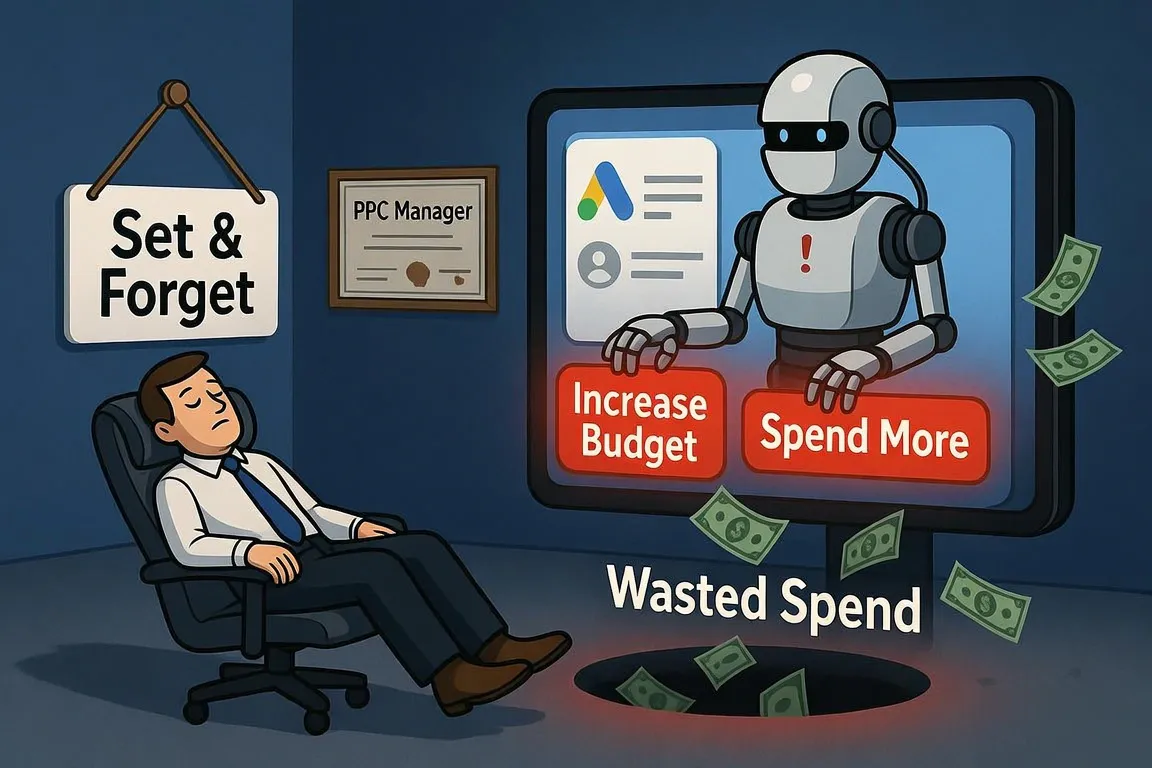
Google Ads fails most businesses because they treat it as set and forget, follow Google's spend-more recommendations blindly, or hire underqualified managers. A real client spent $250,000 (55% of their yearly budget) on irrelevant search terms following Google's advice. With expert oversight, disciplined testing, tight keyword control, and continuous optimisation based on business outcomes, Google Ads can be profitable. Without this, 40-60% of spend is typically wasted.
Google Ads is the world's largest pay-per-click platform. It should be a precision tool for reaching customers actively searching for what you sell. Yet for most businesses, it becomes a budget drain that produces frustration rather than profit.
The problem is not the platform itself. Google Ads can work. The problem is how businesses approach it: treating it as self-service software, delegating it to underqualified staff, or following Google's automated recommendations without understanding the financial incentives at play.
This post explains why Google Ads is not working for so many businesses, what proper management actually requires, and how to audit whether your account is being run for your profitability or Google's revenue.
Why Many Businesses Conclude Google Ads Does Not Work
The typical journey looks familiar. A business owner sets up a Google Ads account, follows the guided setup, perhaps enables "Smart" campaigns or accepts optimisation recommendations. Early results seem promising, then costs climb while returns stagnate. The owner either abandons the channel or keeps spending, hoping the algorithm will eventually figure it out. This pattern stems from fundamental misconceptions:- Google Ads is not a self-service tool for complex businesses. The interface is designed to feel accessible, but effective management requires deep technical knowledge and continuous attention.
- Platform recommendations prioritise Google's revenue. Every suggestion to "increase your budget" or "use broad match" serves Google's interest in more auction participation, not necessarily your return on ad spend.
- Results are delayed and obscured. Poor performance often surfaces months after setup, making it hard to trace waste back to specific decisions.
Business owners then conclude "Google Ads doesn't work for my industry" when the reality is their execution was flawed from day one.
The Hidden Skill and Time Investment Google Ads Actually Requires
Proper Google Ads management is not a side task for a busy owner or a junior marketing coordinator. It demands specialised expertise built through years of account management and substantial ad spend testing.Consider what expert oversight involves:
- Continuous search terms analysis. Reviewing what actual queries triggered your ads, not just the keywords you bid on.
- Strategic keyword architecture. Selecting and refining match types, building negative keyword lists, and understanding how Google's close variants expand reach.
- Conversion tracking verification. Ensuring what Google counts as a conversion actually correlates with business value.
- Landing page and quality score optimisation. Aligning ad copy, landing page experience, and user intent to reduce cost per click.
- Bid strategy testing and calibration. Evaluating whether automated bidding serves your cost-per-acquisition targets or simply spends budget faster.
- Cross-channel attribution awareness. Understanding how paid search interacts with organic search, direct traffic, and other channels.
This is not a ten-minute weekly check. It is ongoing, data-intensive work requiring judgment developed through managing millions in ad spend across diverse accounts.
How Poor Management Leads to Wasted Spend on Irrelevant Search Terms
Here is where budgets bleed out invisibly. Google Ads does not simply show your ads to people searching for your exact keywords. Through broad match expansion, close variants, and partner network placements, your ads appear for searches that share loose thematic connections but zero commercial relevance to your business.Practical examples of waste we see regularly:
- A commercial cleaning company bidding on "cleaning jobs" attracting job seekers, not facility managers.
- A B2B software provider using broad match for "inventory management" showing for "free inventory management spreadsheet."
- A local tradesperson targeting a suburb whose ads appear statewide due to location setting errors.
Without rigorous search terms report review and negative keyword discipline, these clicks accumulate. The business pays for traffic that will never convert, while Google collects the revenue.
A Real-World Caution: When Platform Recommendations Cost $250,000
We audited a client account where the business had spent approximately $250,000 over a year, representing 55% of their annual Google Ads budget, on completely irrelevant search terms. This occurred while following Google's recommendations to expand reach, use broader match types, and increase automated bidding.The recommendations were not technically "wrong" by Google's standards. They increased traffic volume and platform engagement. But they destroyed advertiser profitability by funding clicks with no commercial intent.
This is not an isolated case. It illustrates a systemic conflict: Google's incentive is to maximise auction revenue. Your incentive is to maximise profitable customer acquisition. These are not the same thing, and automated recommendations often serve the former.
Google's Conflict of Interest: Why the Platform Wants You to Spend More
Google's business model depends on auction volume. More advertisers bidding on more keywords at higher prices generates more revenue. This creates structural tensions:- "Raise your budget" prompts appear whenever campaigns hit their daily caps, regardless of whether additional spend produces marginal returns.
- Broad match recommendations expand keyword reach to more auctions, often including irrelevant queries.
- Automated bidding strategies like Maximise Conversions or Target CPA can increase spend while obscuring whether individual clicks were worth the cost.
- Performance Max and similar products remove keyword control entirely, placing budget into Google's black-box distribution.
These tools are not inherently malicious. They can work in tightly controlled environments with robust conversion tracking and sufficient data volume. But for most small and medium businesses, they accelerate waste by removing the granular controls needed to protect profitability.
Mistakes Business Owners Make Running Google Ads Themselves
Self-managed accounts commonly suffer from these errors:- Accepting default settings. Location targeting set to "people in or interested in" rather than "people in" your service area. Search partner networks enabled without evaluation. Display network bundled with search campaigns.
- Neglecting negative keywords. No systematic process for excluding irrelevant terms, allowing waste to compound monthly.
- Using only broad match keywords. Relying on Google's "smart" matching without understanding how aggressively it expands.
- Poor conversion tracking. Counting page views or form loads as conversions rather than qualified leads or sales.
- No landing page testing. Sending all traffic to homepage while competitors build dedicated, relevant experiences.
- Ignoring search terms reports. Never reviewing what actual queries triggered ad spend.
- Setting and forgetting. Launching campaigns then checking only top-level metrics monthly or quarterly.
Mistakes Agencies and Freelancers Make Without Deep Google Ads Experience
Hiring help does not automatically solve these problems. Many agencies and freelancers lack the depth of experience required:- Junior staff managing accounts. The person you speak with sells expertise; the person optimising your account may be learning on the job.
- Template approaches. Applying identical structures across clients without industry-specific keyword strategy or competitive analysis.
- Reporting on vanity metrics. Highlighting impressions, clicks, or click-through rate while avoiding cost-per-acquisition or return on ad spend.
- Accepting Google's recommendations uncritically. Treating platform prompts as best practice rather than revenue-generating suggestions.
- No lead quality feedback loop. Not connecting with clients to understand which leads converted to revenue, optimising instead for volume of any lead.
- Infrequent optimisation. Monthly reporting with minimal intervening account work.
The Technical Foundations: Search Intent, Match Types, Negatives, and Tracking
Profitable Google Ads management rests on controlling relevance at every level.Search intent is the critical filter. Someone searching "what is CRM software" is researching; someone searching "CRM software for small business pricing" is evaluating. Only the latter justifies paid placement for most providers.
Keyword match types determine how strictly Google applies your keyword selections. Exact match (with close variants) offers tightest control. Phrase match allows some additional words. Broad match opens the door to extensive, often unexpected expansion. Expert management typically uses a deliberate mix, with broad match only in carefully monitored campaigns with strong negative keyword foundations.
Negative keywords are your protection against waste. Building comprehensive negative lists, reviewing search terms weekly, and adding exclusions promptly is non-negotiable for cost control.
Conversion tracking must measure actual business value. A form submission is not equal to a qualified lead. A phone call is not equal to a booked appointment. Proper setup requires understanding your sales process and configuring Google Ads to reflect it.
Landing page alignment completes the chain. Ad promises must match page delivery. Quality score rewards this alignment with lower costs and better positions.
The Brand Search Trap: Paying for Traffic You Already Own
A common and costly mistake is heavy spending on brand name searches. If someone searches your exact business name, they already know you. They likely would have reached your website through organic search at zero cost.Defensive brand bidding can make sense in specific competitive situations (competitors bidding on your name, or your organic result ranking below page one). But many businesses allocate substantial budget to brand campaigns without verifying whether this spend simply displaces free organic traffic.
Proper analysis requires comparing organic and paid paths to conversion, not assuming every brand click "would have" converted regardless.
Warning Signs Your Google Ads Account Is Wasting Budget
Review your account for these indicators:- High spend with low conversion volume. Budget is flowing but results are not.
- Rising cost per conversion over time. Efficiency is degrading, not improving.
- Broad match dominates without extensive negative keywords. Relevance control has been surrendered.
- Search terms report shows frequent irrelevant queries. The gap between intended and actual targeting is wide.
- Conversion actions include low-value events. Page views, time on site, or unqualified form fills inflate apparent performance.
- Automated recommendations applied without review. Google's prompts have been accepted systematically.
- No recent negative keyword additions. The exclusion list has stagnated while queries evolve.
- Brand campaigns consume disproportionate budget. You may be paying for traffic you would have captured organically.
What Proper Google Ads Management Looks Like
A well-managed account demonstrates these characteristics:- Structured campaign architecture aligned with business priorities and profit margins, not generic industry templates.
- Tight keyword control with appropriate match type selection, continuous negative keyword refinement, and regular search terms analysis.
- Verified conversion tracking measuring actual business outcomes, not proxy events.
- Deliberate bidding strategy chosen for your data volume and goals, with manual oversight of automated options.
- Landing page relevance tested and improved based on quality score and conversion rate data.
- Regular optimisation rhythm with weekly search terms review, monthly structural adjustments, and quarterly strategic reassessment.
- Cross-channel awareness understanding how paid search complements or displaces organic and other channels.
- Profitability-first reporting focused on customer acquisition cost, return on ad spend, and lead quality, not platform metrics.
Why Continuous Data-Driven Optimisation Is Non-Negotiable
Google Ads is not a machine you build once and let run. Auction dynamics shift constantly: competitor bids change, search behaviour evolves, Google's algorithms update, and your own business circumstances transform.Continuous learning is imperative. Every significant data point, whether a surprising search term, a conversion path anomaly, or a seasonal performance shift, must feed back into account structure and strategy. Accounts that plateau in optimisation typically plateau in results, then decline as market conditions move past them.
The path to profitability requires persistent testing: of keywords, ad copy, landing pages, bid strategies, and audience definitions. This testing must be disciplined, with clear hypotheses, controlled variables, and outcome measurement tied to business results.
The Honest Reality: Google Ads Can Work, But Most Accounts Waste 40-60%
Google Ads is absolutely capable of driving profitable customer acquisition. We have managed accounts that deliver consistent, scalable returns. But this is not the typical experience.From what we see across audits and new client accounts, 40-60% of spend is complete waste. Not suboptimal allocation. Not merely "could be better." Waste on irrelevant queries, misconfigured settings, untracked outcomes, and recommendations that served Google's revenue rather than advertiser profit.
For a small or medium business, this level of inefficiency makes Google Ads an unprofitable pursuit. The owner concludes the channel does not work, when the truth is their execution was never given a genuine chance to succeed.
Practical Steps to Improve Performance or Audit Your Agency
If you suspect your Google Ads account is underperforming, take these actions:- Review your search terms report for the last 90 days. Identify what percentage of queries were genuinely relevant to your business. If you cannot access this, your agency should provide it immediately.
- Audit your conversion tracking. What events are counted as conversions? Do they correlate with actual revenue or qualified leads?
- Check your keyword match type distribution. Is broad match dominant? Are negative keywords present and recently updated?
- Evaluate location and network settings. Are ads appearing where your customers actually are, or where Google's defaults placed them?
- Analyse brand vs. non-brand spend. What proportion of budget goes to searches for your own name?
- Request a clear profitability report. Not clicks, impressions, or CTR. Cost per acquisition, return on ad spend, and lead quality assessment.
- Question every automated recommendation. Ask your manager or agency to explain the business logic, not just the platform logic, for each accepted suggestion.
- Consider a professional Google Ads audit. An independent review can reveal structural waste that internal or incumbent reviews miss.
If you are managing campaigns yourself and recognise these gaps, honest assessment is the first step. The time investment for genuine expertise may exceed what your business can sustainably provide, making professional Google Ads management a consideration worth evaluating against your current waste levels.
For broader pay-per-click strategy, including PPC management across multiple platforms, integrated oversight often reveals efficiencies that isolated channel management misses.
FAQs
Google Ads often fails small businesses because owners underestimate the expertise and time required, accept default settings and recommendations, and lack systems to monitor relevance and waste. The platform is accessible to set up but difficult to run profitably without experience.
Google Ads is not inherently a waste, but it commonly becomes one through poor setup, underqualified management, and blind acceptance of platform recommendations. Audits typically find 40-60% of spend could be eliminated with no loss of genuine conversions.
Google's revenue depends on auction volume. Budget increase prompts are designed to capture more auction participation, not to guarantee your profitability. Each recommendation should be evaluated against your business goals, not accepted automatically.
Common mistakes include relying solely on broad match keywords, neglecting negative keywords, poor conversion tracking, sending traffic to generic landing pages, failing to review search terms reports, and treating campaigns as set-and-forget.
Demand reporting on profitability metrics (cost per acquisition, return on ad spend, lead quality), not vanity metrics. Ask for evidence of regular search terms review, negative keyword maintenance, and strategic testing. Be wary of agencies that cannot explain why they accepted specific Google recommendations.
A Google Ads audit is an independent review of account structure, keyword strategy, match types, negative keywords, conversion tracking, bidding approach, landing page relevance, and historical performance. It identifies waste and prioritises fixes for profitability.
Brand bidding can be justified defensively if competitors target your name or your organic ranking is poor. However, many businesses overspend on brand without verifying whether they are simply paying for traffic they would have received organically for free.
There is no fixed timeline. Accounts with proper tracking, relevant targeting, and continuous optimisation can show improvement within weeks. Accounts with structural waste may require months of remediation before genuine testing of profitable strategies can begin.
Google Ads management focuses specifically on Google's search, display, and video platforms. [PPC management](/ppc-management) encompasses paid advertising across multiple platforms, potentially including [Meta Ads](/meta-ads) and others, with coordinated strategy.
For very simple campaigns with limited budgets and narrow targeting, self-management is possible. For most businesses with meaningful ad spend, the complexity of proper optimisation typically exceeds the time and expertise available internally.

Digital Growth Marketer / Founder
12+ years of experience managing over $100 million in ad spend. I started by building my own ecommerce business, which shaped my approach to efficient growth, then went on to help established brands scale through performance channels. My focus is data-led strategy and honest advice about what will actually work for each brand. Outside of work, I stay active across a bunch of sports, head to the mountains when I need perspective, and occasionally let the ocean reset everything. I'm enjoying this very temporary existence and trying to stay a curious student of this universe.