
When to Recommend Performance Max vs Search Campaigns

TL;DR Performance Max is powerful when the foundations are right, but it is not a replacement for well-built Search campaigns. This guide gives agency practitioners a clear framework to decide when to recommend PMax, when to stick with Search, and how to avoid the most common and costly mistakes.
Start with Search first
A strong Search campaign remains the best foundation for most Google Ads accounts in Australia. It gives you precise control over high-intent keywords, clean data for Google's algorithm to learn from, and transparent search term reporting. Only once Search is performing well and generating consistent conversions should you consider adding Performance Max.When Performance Max makes sense
PMax earns its place in specific situations. Recommend it when the account has:- Strong conversion tracking (including offline or enhanced conversions where possible)
- Budget large enough to generate at least 30 conversions per month
- Quality creative assets (images, videos, headlines) ready to test across channels
- First-party data or customer match lists available
- E-commerce with a reliable product feed, or lead generation with clear lead qualification
In these conditions PMax can deliver incremental reach across Search, YouTube, Display, Discover and Maps while freeing up time for strategic work.
When to stick with standard Search
Many accounts — especially smaller or service-based businesses — are better off staying with (or heavily prioritising) standard Search campaigns. Google reps often push PMax hard because it tends to increase overall spend, but that does not mean it is the right choice for every client.PMax operates as a black box. Google asks you to trust the algorithm without giving the same level of visibility into search terms, placement performance or optimisation levers that you get with standard Search. For practitioners with time and skill, this lack of transparency can be frustrating.
Red flags for recommending PMax include:
- Monthly budgets under $1,500–$2,000 AUD
- Weak or incomplete conversion tracking
- Limited or low-quality creative assets
- Service businesses with complex lead qualification needs
- Accounts where lead quality and close rates matter more than volume
In these cases PMax often optimises for cheap conversions that do not turn into profitable customers.
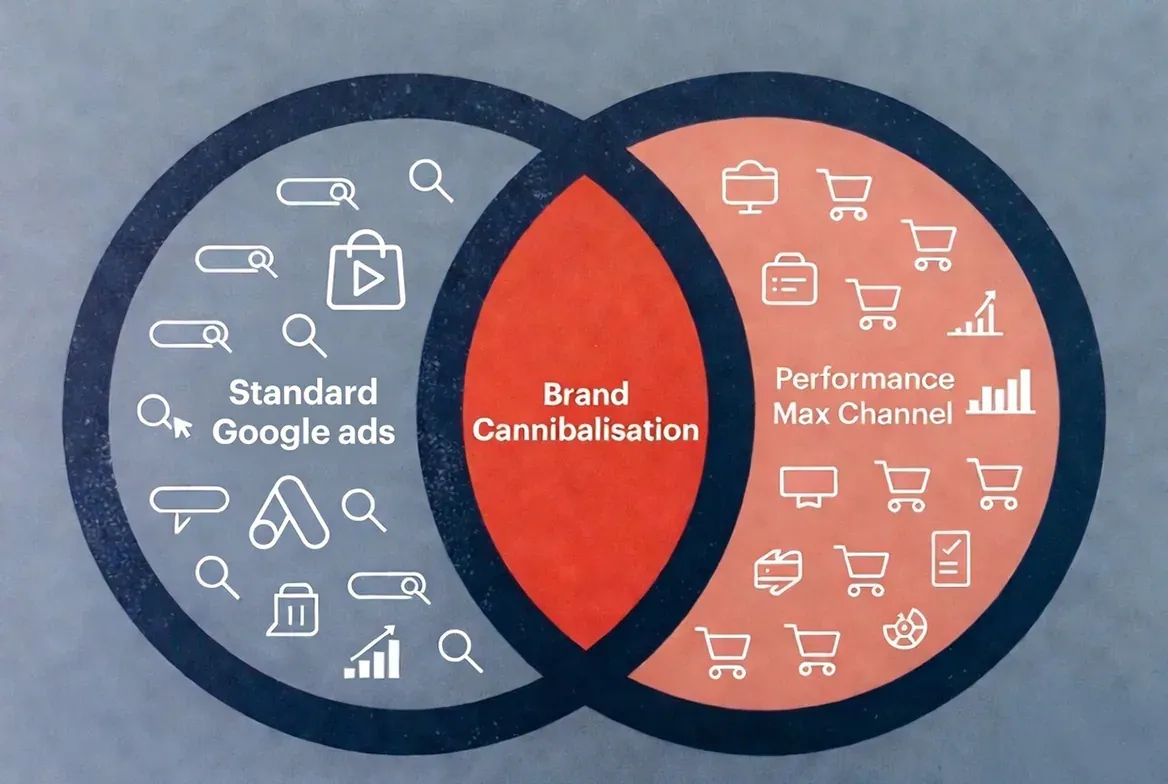
The brand cannibalisation trap
If you are not actively checking your PMax search terms, this is probably happening to you. PMax frequently captures branded traffic that would have come through your Search campaigns anyway. You end up paying for customers who were already searching for your brand.Use campaign-level negative keywords (now available to all advertisers) to protect your brand terms. Monitor branded Search volume after launching PMax. If it drops noticeably, something is leaking.
The honest conversation with clients
As agency practitioners our job is to give clear, commercially grounded advice. Tell clients:- PMax is not a set-and-forget solution
- It works best as a complement to strong Search, not a replacement
- Proper setup requires investment in tracking, creative and ongoing oversight
- We will only recommend it when the data and assets genuinely support it
This honesty builds trust and protects client budgets, especially for smaller businesses where PMax is frequently pushed but often underperforms.
Make better recommendations
Performance Max is a valuable tool in the right conditions. For many Australian accounts, however, a well-optimised Search campaign still delivers the clearest results and easiest optimisation path. Use this framework to assess each account honestly. Start with Search, add PMax only when the foundations are solid, and always protect against brand cannibalisation. Your clients and your margins will thank you.FAQs
No. Most accounts perform best with strong Search as the foundation and PMax as an additional layer for broader reach.
Add brand terms as campaign-level negative keywords in PMax and monitor branded Search volume closely after launch.
Aim for enough spend to generate at least 30 conversions per month so the algorithm has enough data to optimise effectively.
It can work but only with strong conversion tracking and lead qualification. Many service businesses still see better results from focused Search campaigns.
Check search term reports for overlap with Search campaigns and monitor branded traffic changes. True incrementality requires careful measurement beyond platform-reported conversions.

Digital Growth Marketer / Founder
12+ years of experience managing over $100 million in ad spend. I started by building my own ecommerce business, which shaped my approach to efficient growth, then went on to help established brands scale through performance channels. My focus is data-led strategy and honest advice about what will actually work for each brand. Outside of work, I stay active across a bunch of sports, head to the mountains when I need perspective, and occasionally let the ocean reset everything. I'm enjoying this very temporary existence and trying to stay a curious student of this universe.